
Software-Defined X-Ray Imaging
Multi-beam architectures replace mechanical rotation with electronically orchestrated beam control.
Technology Overview
How the Multi-Beam Architecture Works

Field Emission at Room Temperature
The system uses cold field-emission emitters instead of thermionic filaments.
Electrons are extracted through quantum tunneling, eliminating heat generation and enabling dense emitter arrays within a single tube.

Pixel-Level Electronic Control
Each emission pixel can be addressed individually and switched within microseconds.
Beam generation is synchronized precisely with detector timing – radiation is produced only when required.

Electronic Beam Sequencing
Multiple focal spots are activated in rapid succession, replicating and exceeding the effect of a rotating gantry, but without any moving parts.
From Rotation to Control
From Mechanical Constraint to Electronic Architecture
Conventional CT systems are defined by rotation.
A single focal spot is mounted on a moving gantry, requiring mass, bearings, cooling and structural support.
Mechanical inertia limits scan dynamics, introduces vibration and motion blur, and increases maintenance complexity.
The multi-beam architecture removes the mechanical dependency entirely.
Scan performance is no longer determined by rotating hardware, but by electronics and software control.
The Multi-Beam Principle
01
Cold Cathode Emission
Cold field-emission cathodes replace thermionic filaments and operate at room temperature.
Electron extraction through quantum tunneling eliminates thermal stress and enables dense emitter arrays within a compact tube architecture.
02
Microsecond Switching
Each emission pixel can be switched within microseconds and synchronized precisely with detector timing.
This enables true pulsed operation and projection-level dose control.
03
Dense Emitter Arrays
Multiple individually addressable focal spots are integrated within a single tube architecture.
The compact pixel design enables new static CT geometries without thermal limitations.
Integrated Platform
Stretta Integrated System (SIS)
The multi-beam architecture is not a distributed source concept added to a legacy power architecture.
It is engineered as an integrated platform.
The Stretta Integrated System (SIS) combines:
- multi-beam emitter arrays
- Electronic Control System (ECS)
- Ultra-fast High Voltage Generator (HVG)
The ECS enables microsecond switching and closed-loop monitoring, allowing emitter-level addressing and projection-specific dose control.
The HVG is designed for rapid load dynamics and high switching frequencies, ensuring stable spectral control under pulsed operation.
Source, control and high voltage are co-designed as one architecture, not retrofitted components.
System Impact
Engineering New CT Possibilities
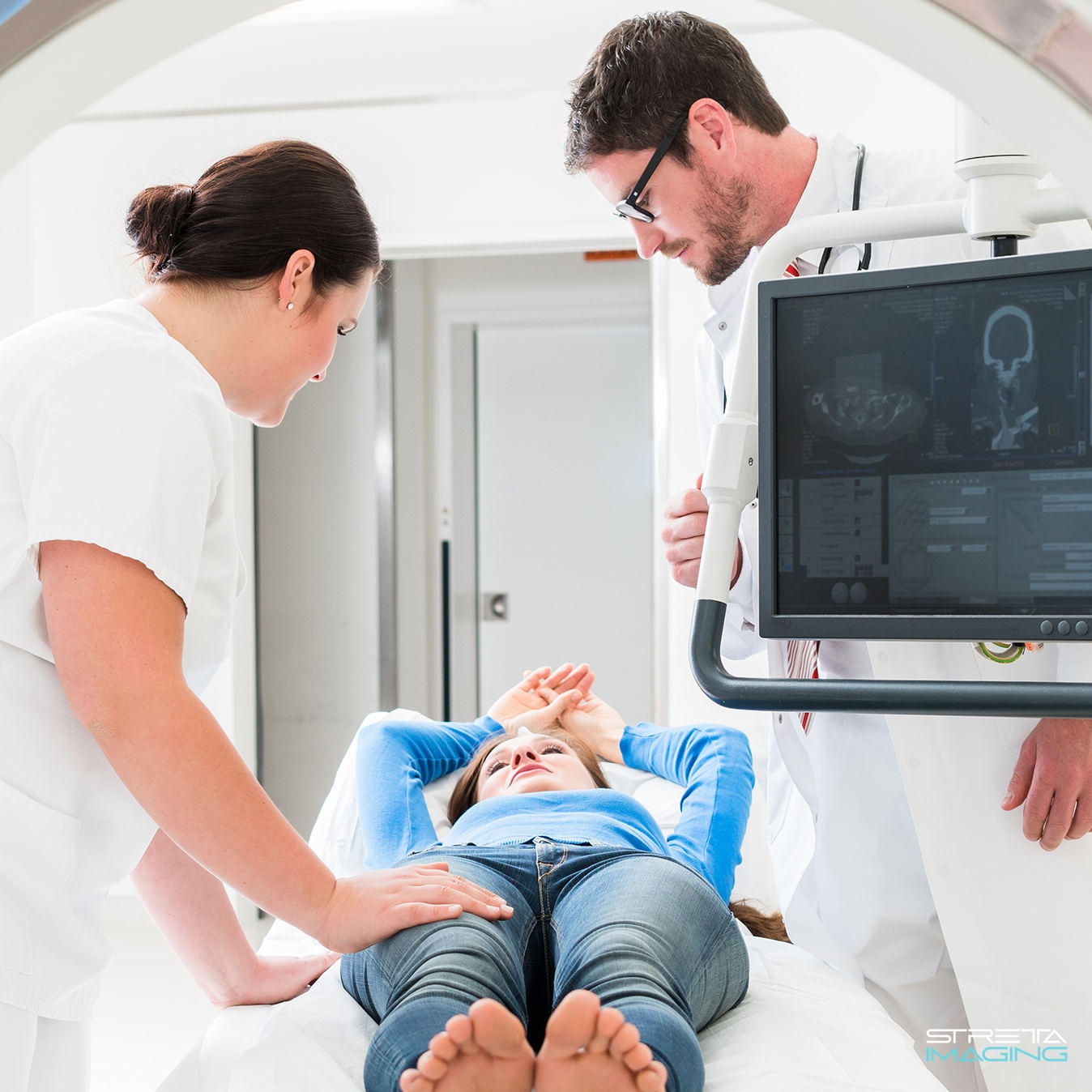
Static & Compact CT Architectures
Elimination of rotational mass enables compact, lightweight and scalable system designs.

Portable Head & Full-Body Concepts
Compact static gantries support mobile stroke care and bedside imaging applications.
Real-Time Intraoperative Imaging
Electronic beam sequencing enables fast temporal resolution for hybrid operating rooms.
Dose Reduction by Design
True pulsed emission minimizes unnecessary exposure during detector readout phases.
Engineering the Electronic Future of CT
NTMBX™ is designed for OEM integration across medical, security and industrial systems.
From hardware-defined motion to software-defined beam control.
Prototype multi-beam tubes have already been delivered and quality-accepted by a top-tier OEM for airport baggage CT applications.
In the medical domain, a portable stationary CT collaboration has been formalized through a Letter of Intent with a leading global CT manufacturer.
Functional demonstrators for static digital breast tomosynthesis have been successfully evaluated by specialized partners.
The platform is engineered for productization, not laboratory demonstration.