
Medical Platform
Static Digital Chest Tomosynthesis
Thoracic imaging takes place in a dynamic environment shaped by respiration and cardiac motion. STRETTA’s Static Digital Chest Tomosynthesis replaces mechanical source sweep with electronically sequenced multibeam emission, enabling projection geometry defined by control electronics rather than moving mass.
Clinical Environment
Imaging in a Continuously Moving Anatomy
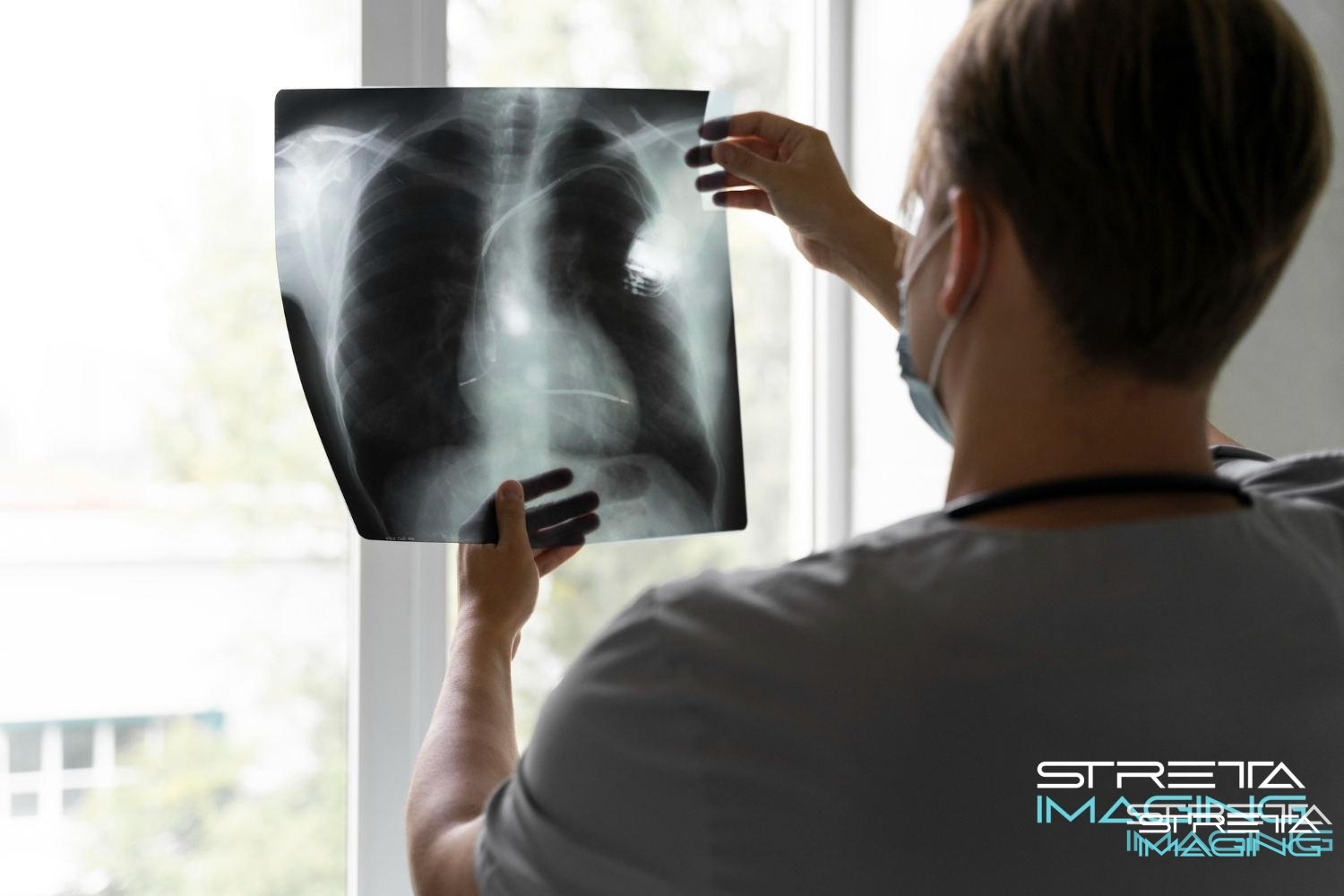
Chest imaging is inherently affected by respiratory motion, cardiac activity and involuntary patient movement. Digital chest tomosynthesis was introduced to reduce anatomical superposition compared to standard radiography, improving lesion visibility in the thorax.
Conventional systems, however, rely on mechanical tube sweep across an angular arc to acquire projections. Even in optimized configurations, this motion introduces structural limits that affect stability and reproducibility.
Architectural Constraint
Mechanical Sweep Limits Projection Stability
Acceleration constraints restrict angular velocity. Focal spot displacement during exposure introduces motion blur. Extended acquisition windows increase susceptibility to respiratory artifacts. Over time, mechanical wear affects geometric stability and calibration precision.
As long as projection geometry is created by moving mass, image stability remains bound to the physics of motion.
Detector performance and reconstruction algorithms cannot compensate for this structural dependency.
System Architecture
Electronically Defined Projection Geometry
STRETTA’s static chest tomosynthesis platform eliminates mechanical sweep entirely. Multi-beam emitter arrays distribute focal spots along the required angular geometry and activate them in microsecond-scale electronic sequences, defining projection angles electronically rather than mechanically.
There is no focal spot displacement during exposure. Multi beam technology enables precise gating of individual emitters, synchronizing radiation generation with detector readiness and minimizing unnecessary exposure.
The platform operates within the STRETTA Integrated System (SIS). The Electronic Control System (ECS) regulates emitter sequencing and current stability, while the High Voltage Generator (HVG) maintains consistent energy output during rapid pulsed transitions. Together, these subsystems ensure stable projection geometry, reduced motion-induced blur and improved reproducibility over the system lifetime.