
Medical Platform
Portable Static Head CT
Acute neurovascular emergencies demand immediate imaging.
STRETTA’s Portable Static Head CT enables tomographic diagnostics directly in ICU and emergency environments, without reliance on centralized radiology infrastructure.
Clinical Reality
Imaging in Time-Critical Neurodiagnostics
In stroke and severe neurological emergencies, minutes influence outcome. Transporting unstable patients through hospital infrastructure delays diagnosis and increases workflow complexity.
While mobile CT systems reduce distance, they remain based on rotating gantry architectures that define system size, weight and mechanical constraints. Thermionic cathode technology further limits precise gating and synchronization of X-ray emission during fast pulsed operation.
These limitations are structural rather than logistical.
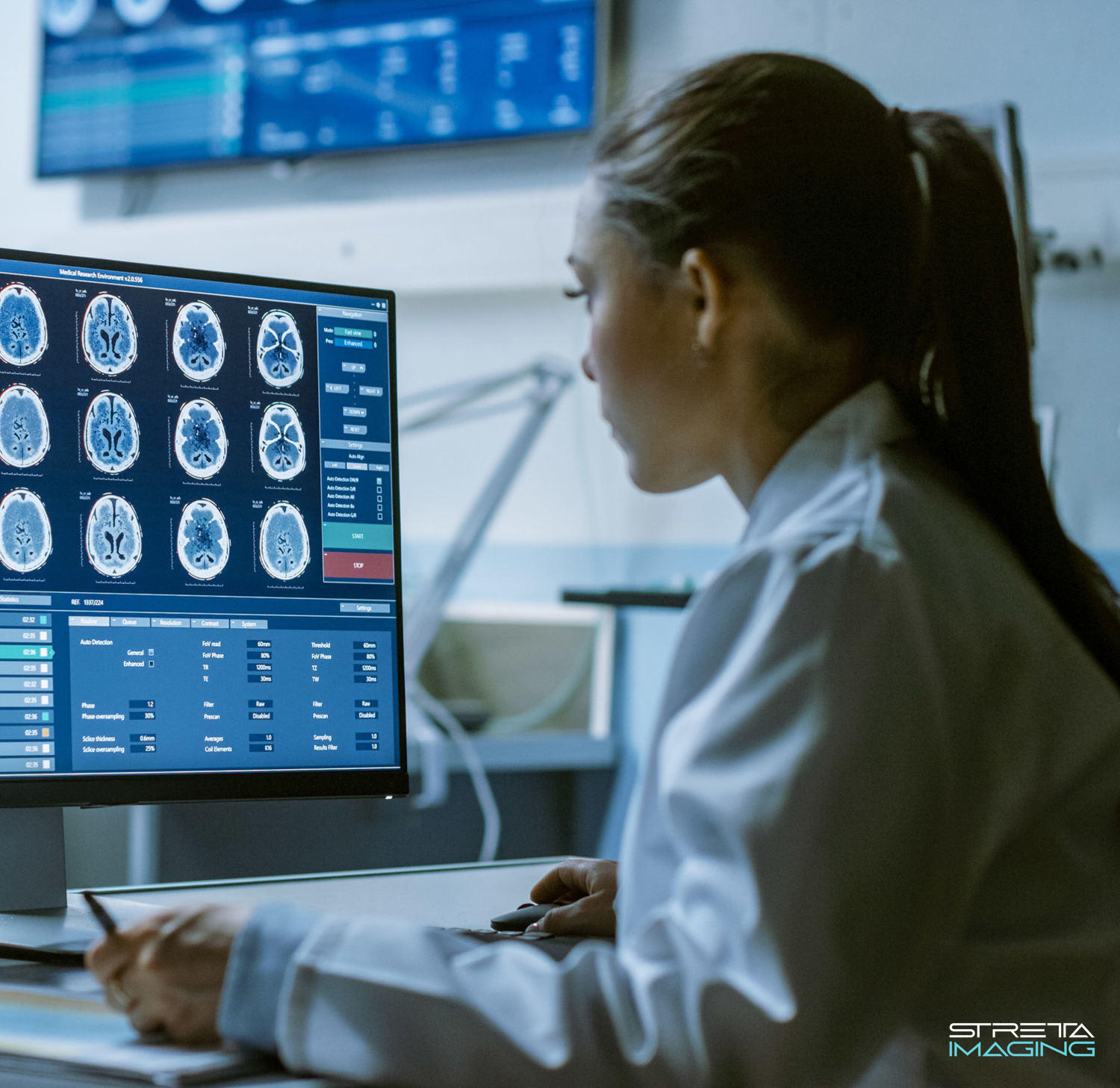
Static multibeam tomography enables portable CT imaging in critical care environments.
System Architecture
Static Multibeam Tomography
The Portable Static Head CT platform is based on STRETTA’s multi-beam technology. Multiple focal spots are electronically sequenced around the imaging volume while the gantry remains stationary.
Removing rotating components reduces mechanical complexity and overall system weight. The compact architecture enables integration directly into ICU rooms, emergency departments and future mobile care platforms while maintaining full tomographic capability.
Emission Control
Deterministic X-Ray Generation
X-ray source enables microsecond-level activation and deactivation of individual emitters. X-ray generation is synchronized precisely with detector readiness, improving temporal accuracy and dose control. The platform is powered by the STRETTA Integrated System (SIS). The Electronic Control System (ECS) governs emitter sequencing and current regulation, while the High Voltage Generator (HVG) ensures stable energy output during rapid pulsed operation. Together, these subsystems provide consistent spectral performance and geometric stability under clinical conditions.
Industrial Validation
Developed in OEM Collaboration
The Portable Static Head CT architecture has been evaluated in structured collaboration with leading global medical imaging OEMs. A formal Letter of Intent confirms strategic alignment on stationary CT system development.
Feasibility programs have included image-chain simulation, reconstruction validation, calibration strategy development and prototype integration planning.
This platform is being developed within established industrial frameworks and long-term system integration roadmaps.
Clinical Impact
CT at the Point of Care
The Portable Static Head CT platform supports decentralized neuroimaging workflows. By integrating CT directly into intensive and emergency care environments, diagnostic decisions can be initiated without infrastructure-dependent delay.
In acute stroke management, system architecture directly influences response time. Portable static CT enables imaging where critical care decisions are made.