
Medical Platform
Portable Full-Body CT for Hybrid OR
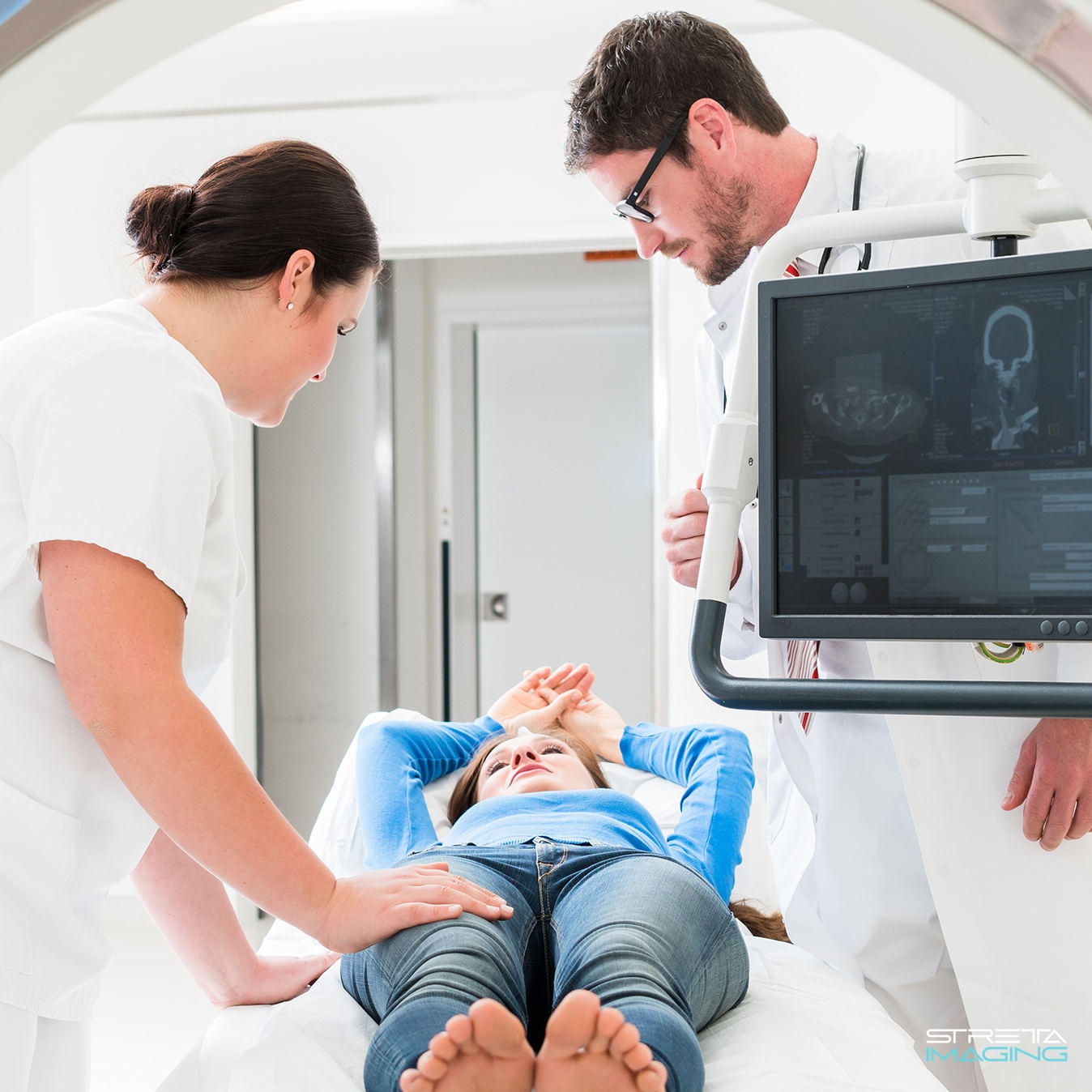
Hybrid operating rooms require volumetric imaging without interrupting surgical workflows. STRETTA’s Portable Full-Body CT replaces mechanical rotation with electronically sequenced multibeam technology, enabling static tomographic acquisition designed for seamless integration into hybrid OR environments.
Operating Environment
Imaging Within the Surgical Ecosystem
Hybrid operating rooms are evolving from sequential imaging toward continuous, precision-guided intervention. Robotics, navigation systems and minimally invasive procedures increasingly depend on high-quality volumetric imaging directly in the operating room.
Conventional CT systems were not developed for this level of integration. Their architecture is built around mechanically rotating gantries, a design principle that introduces structural constraints within modern surgical environments.
Architectural Limitation
Mechanical Rotation Defines System Integration
Rotating gantry CT systems require reinforced structures, generate vibration during acceleration and impose inactive phases that limit rapid start–stop acquisition. Their geometry can obstruct surgical access, and installation often requires dedicated shielding volumes and complex planning.
Even advanced C-arm solutions attempting 3D imaging remain dependent on motion-based acquisition. As long as projection geometry is created by moving mass, system size, integration complexity and workflow flexibility remain mechanically determined.
System Architecture
Static Multisource Full-Body Tomography
STRETTA’s Portable Full-Body CT eliminates mechanical rotation. Using STRETTA’s proprietary electronic beam sequencing, spatially distributed focal spots are activated in deterministic electronic sequences while the gantry remains mechanically static.
Projection geometry is defined electronically rather than mechanically produced. By decoupling acquisition from rotating mass, the platform enables slimmer and potentially retractable gantry configurations, eliminates rotational vibration and improves spatial access for surgical teams.
Intraoperative Performance
Acquisition Governed by Electronics
Acquisition speed is determined by electronic switching rather than acceleration curves. Imaging sequences can be initiated and terminated without mechanical ramp-up or spin-down phases.
This allows volumetric imaging to integrate into real-time intraoperative workflows as an embedded system component rather than an external imaging step.
Industrial Validation
Evaluated in Structured OEM Programs
The stationary full-body CT concept has been assessed in structured feasibility programs with major medical OEM partners. These evaluations included CT image-chain simulations, multi-source geometric calibration modeling, reconstruction validation, phantom-based image testing and preparation for clinical study pathways.
At the core of the platform is the STRETTA Integrated System (SIS). The Electronic Control System (ECS) coordinates nanosecond-precise emitter switching, while the High Voltage Generator (HVG) maintains stable spectral output under rapid pulsed load conditions. Together with STRETTA’s multibeam x-ray technology, the system ensures reproducible focal geometry and consistent volumetric image quality.